
Generative UI: a glimpse into the future of digital experience

The launch of Gemini 3 did more than shipping a powerful model. It turned on generative UI at scale and delivered the clearest proof yet that the era of landing on someone else’s pre-built homepage and hunting for the right menu item will soon come to an end.
The absurdity we’ve all normalized
Very often, users just want an answer or to get something done. Instead we hand them a navigation map, force them to reverse-engineer someone else’s mental model, and feel disappointed when they bounce. That’s why Google’s AI Overviews are eating clicks alive. Maybe people aren’t lazy, they’re just exhausted.
Thanks for reading AIConverge! Subscribe for free to receive new posts and support my work.
Meanwhile, marketers and PMs spend hours on research, heat-maps, and A/B tests trying to build the “One Information Architecture” to rule them all that works for ~80 % of visitors. We high-five over that number while quietly admitting we just wasted everyone’s cognitive budget on learning curves that have little to do with why they showed up. But that’s inevitable because the underlying technologies can’t enable more than that.
Google has done a terrific job in the past decades in collapsing the distance to the answer. While chat-based AI advances it, it’s still far from ideal as it only replaces fixed navigation with linear text scrolls and bunches of outbound links. Good enough for now, prehistoric by 2026.
Enter generative UI: intent first, followed by interface
Gemini 3’s generative UI treats the interface as a real-time collaboration around intent instead of a pre-built cathedral you have to explore.
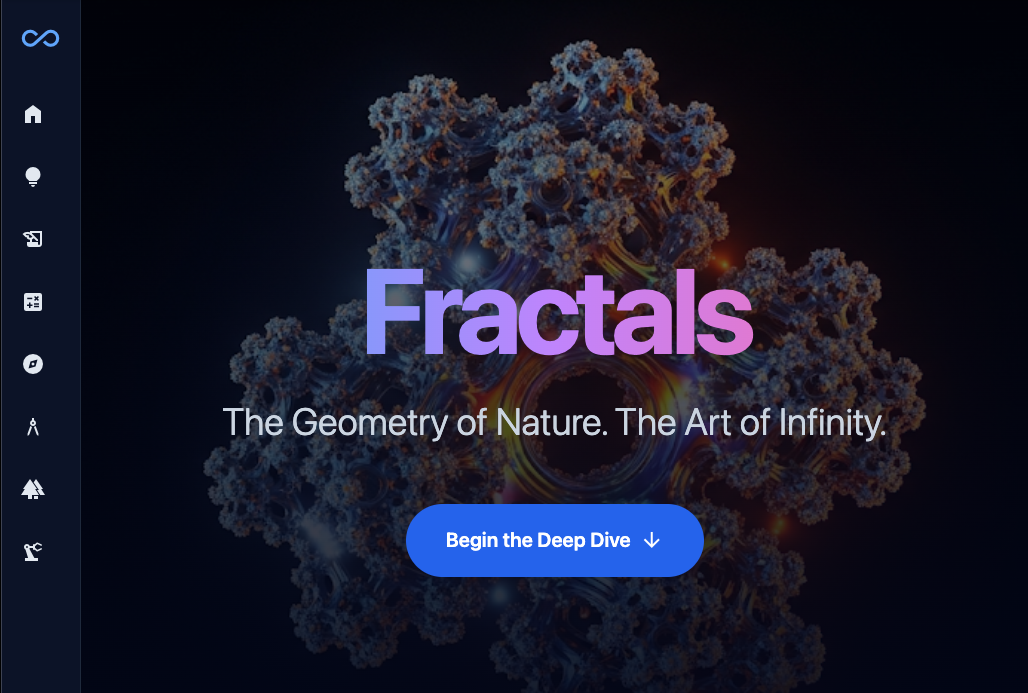
Caption: I particularly liked this Fractals example in Google’s research paper. It provides a glimpse of what future information access can look like. More examples.
Imagine this flow:
You land → the system asks “What are you trying to achieve today?”
You answer in plain language.
Thirty milliseconds later a bespoke experience assembles itself: right depth, right media mix, right controls — tuned to the device you’re on, the time you have, and the expertise you possess (=context).
It doesn’t stop at assembly, it anticipates:
Pre-stages the comparison table you’re 90 % likely to need next
Surfaces the gotcha that trips most people with your exact scenario
Lets you fork the page (“now show me enterprise scale”) without losing context
And then it hands you the keys - real interactivity, not just reading:
Drag sliders and watch pricing or performance update live
Toggle features on/off and instantly see the impact on recommendations
Drop in your own data (spreadsheet, screenshot, PDF) and the UI absorbs it, re-running calculations or comparisons with your numbers
Finally, users can flip the power entirely by being the designer without writing code how the information should be organized and displayed. Check out my quick 5 minutes work on this ApexBio site that shows the biomechanics of a few predators.
This is live inside Google products today, in lightweight form. Give it a bit more time, it can ship a “Google Search Appliance 2.0”, so that every organization or individual has a generative front door that turns content firehoses, pricing, docs, videos, calculators, and brand voice into on-demand, intent-shaped experiences for their target audience.
Even better: portable lego pieces
How we save the things we love today is a rather sad story. We bookmark the page (hoping the site doesn’t redesign and break the link), screenshot it, copy-paste chunks into Notion or Apple Notes, or email it to ourselves. It’s digital hoarding dressed up as productivity: fragmented, brittle, and completely detached from context.
So on my wishlist, these artifacts produced by the generative UI should become portable like lego pieces. That pricing comparison you loved? Save it. That interactive calculator tuned to your scenario? It lives in your personal knowledge base now — searchable, remixable, evolving as by-product of doing, not as upfront tax.
I happened to briefly involve in iGoogle project two decades ago. The product got sunset at the age of 8. In retrospect, I think it’s because we asked users to pre-commit to interests that change from time to time. While this time personalization is the outcome, not the onboarding chore. I am really pumped up.